Faking It

I had to go to the public school yesterday. Another time I’ll blog about the details of why and the “horrors” of the whole experience, but for now, I just want to comfort every parent who has ever spotted a “perfect” family and felt inferior: maybe it’s all a farce.

Knowing that I had to make this little trip with all six kids in tow, I made sure that everybody was dressed decently: not Sunday best, but nothing was dirty, stained, ripped or mismatched (and that is quite a feat for an early Wednesday morning).

I brushed the girls’ hair (a really big deal).

I had my three oldest get the books they were reading for history. I had my three youngest select picture books of choice. Naturally, one child had to pick a coloring book and then wanted to lug the big bucket of pens, pencils, and crayons along. I told her to select 5 crayons; she picked 5 colored pencils. Whatever.

I sat the girls down and talked to them, and then a bit later called the boys to attention (they love drill and ceremony and know I’m serious when I call them to attention and deliver “marching orders”). I explained that public schools do not tolerate barbarians. I laid out my expectations in the sternest terms: speak only when spoken to, no yelling, no running, no arguing (with each other or me).

I told them they were to sit quietly and read their books the entire time we were there. This generated arguing on the part of one child (unnamed) who felt that this was tyrannical. (S)he felt that reading for a bit and then doing some other activity should suffice and that (s)he was perfectly capable of good behavior without a specific task to keep her/him occupied. This is the exact reason I explained my expectations clearly, in advance. Said child was sternly reminded of her/his call to obedience and told that this was absolutely not a situation where any flexibility regarding the terms of behavior would be granted.

And then we went, and they sat, and they read, and they spoke when spoken to and not otherwise, and they were, in all ways, perfect. Model children. Beautiful.

Even the baby was perfect: she kept walking out the office to stand in the hall and had to be brought back in; she had a temper tantrum in the conference room because she was bored and upset that she had to stay with me and not her siblings; and she emptied my purse and got really, and loudly, mad when I took all the coins away from her. This is perfect because she behaved just exactly right for her age which proved that my children were normal and not robots or extraordinarily passive-submissive types.

I was beyond proud of my kids.

And then, immediately upon leaving the building, they started fussing with each other, jostling over who would get in the car first, whining about being hungry and thirsty, complaining about my proposed snack upon our return home, arguing over the need to do schoolwork after snack, and crying because somebody in the back row kicked the seat in their row and it “hurt.”

Grace period: over.

So, the next time you see immaculately dressed children sitting perfectly still and behaving in such an exemplary manner that you are tempted to judge yourself an inadequate parent, consider the possibility that it is all a show. And although I can’t speak for the Smiths or the Joneses, I will say that if the last name is Reitemeyer, we’re just faking it.

Education

How to Wake Up Slumbering Minds

The point of this article, though it doesn’t say it, is that kids need to be taught how to think (aka: a classical or even traditional education). Most homeschoolers are checking this block. It is the public school systems that care more about test results than true education who have failed in this regard. I don’t know what the answer is. Schools need to be accountable for children’s educations, and we need some way to measure that (testing). Trust me, I understand the pressures of having a child pass the test. But I worry about that one mere week a year, not all year long.

Love this quote from the article: Mr. Willingham makes a convincing case that the distinction between visual, auditory and kinesthetic learners (who supposedly learn best when body movement is involved) is a specious one. At some point, no amount of dancing will help you learn more algebra.

Old fashioned memorization and drilling in the younger grades has proven over centuries to raise intelligent thinking adults. Are the public schools ever going to learn from their successes?

Teacher Inservice Day

I told Bill I needed four days.

Two days at home in June without kids to go through the syllabi for next year, make my weekly plans, and physically organize the schoolroom. I can’t effectively do that while changing diapers, breaking up squabbles, and cutting PB&J sandwiches into crustless circles.

Two days to mentally prepare for next year by attending homeschool conferences. In June, I’ll go to the IHM Conference, which is local to me. I’m waiting for the schedule to come out so I can plan which day I’ll go.

This Saturday, I’m heading up to Jersey for the CHAPLET Homeschool Conference. I hope to see some old friends there, and maybe meet some new ones.

Anybody else heading to either of these conferences?

Progress Reports

At school this week, we’re working on Week 19 out of 32. I think Week 20 is one of my favorite weeks, because 20 seems so close to the end. We’re well past half-way at this point, and it feels so good.

It’s also a good time to do progress reports. How are my students doing, and how am I doing as a teacher?

Reading:

Fritz finally seems to enjoy reading just to read. Of course, there are a million better ways to spend an afternoon, in his opinion, but it isn’t torture to get through a book. And bedtime reading is just fine. He still rushes and guesses words, and reads to get the gist more than full comprehension, but it’s definitely better. (Grade: B)

Billy is a strong and diligent reader. We have finished his Language Arts book already, and I’m just supplementing with other things for the rest of the year. (Grade: A)

Katie was having enough difficulty with her reader (Reader D of the Little Angel Reader series) that I stopped two weeks ago and made her go back to the beginning. She will read a word list with “aw” and “au” words just fine, and then completely forget how to pronounce those vowels three days later when we move on. It’s frustrating. I guess she just needs more practice. (Grade: C)

Jenny is starting to remember the names of letters and the sounds they make. She is nowhere near to being able to put those sounds together to form words. She is young, and I would not have put her in kindergarten this year if she attended a traditional school, so I’m happy with her progress. (Grade: VG)

Writing:

Fritz is working hard on formulating coherent paragraphs. He is learning how to use an outline to lay out his thoughts. He’s doing okay, depending on his mood and the assignment (if the subject is history, he enjoys the assignment; if it’s creative writing – “imagine you are a drop of water” – he mentally digs in his heels and seems unable to come up with a story). His handwriting is as neat as he wants it to be. His spelling is atrocious, but he’s progressing. (Overall Grade: B)

Billy is mostly doing copy work and retelling stories which I write for him to copy. He does fine, but has cleverly figured out that the shorter his oral narration, the less writing he has the next day. His handwriting is fine and his spelling is progressing. (Overall Grade: B+)

Katie is working on writing single sentences. She is capable of coming up with answers to her assignments, but asks how to spell every word. Her handwriting is getting better, and her spelling, when left to herself, is…creative. When she does writing on things not for school, she is freer in her expression and works independently. (Overall Grade: B)

Jenny is working on forming letters. She is progressing. (Grade: VG)

Arithmetic:

I pushed Fritz into 6th grade math this year (don’t tell him that though). It is challenging, but he is learning the material. (Grade: B)

Billy, like Fritz, has been pushed up a grade and is doing 4th grade math. Same difficulties, same results. (Grade: B)

Katie is progressing nicely in 2nd grade math. Some days she does better than others. (Grade: B)

Jenny has made progress in counting, identifying numbers, and in writing numbers. She had been forming most numbers backward, but now self-corrects most of the time. She is learning to add numbers, and is having no trouble with that concept. (Grade: O)

Other:

Katie seemed completely unable to memorize the states and capitals using flashcards. I tried to use written reinforcement, but even after printing “Montgomery, Alabama” three times a day for two months, she still could not tell me Alabama’s capital on a consistent basis. I just bought a states and capitals wooden puzzle with the capitals named under the pieces. She seems to be doing better, although I started on the West Coast.

Billy is able to do his science and history reading independently. This is tremendously helpful to me.

I am trying to get Fritz to work independently, but it is harder for him. He does well on history, average on science, and is terrible on Latin (note, in case Fritz reads this: I do not think Fritz is terrible in Latin, I think he is terrible in working alone on Latin). This week, we went all the way back to Lesson I and II to review the material. I do not think we will finish Latina Christiana I this year. That’s okay.

Teacher Self-Review:

Having four students plus a preschooler and a toddler is rough. The imperative goal for a diverse classroom is that older students be able to function on their own more and more. This requires me to let go and my students to pick up the slack. We’re muddling through. We’re better now than we were at the beginning of the year, but I still want to check that every i is dotted and t crossed. It is easier for me to let Billy work alone, since his reading skills are stronger and I read that material when Fritz was in 3rd grade.

It is also hard for me to accept that my children are not straight-A students. (Not the math grades, with which I am quite pleased, but in other subjects.) I was reading many grade levels ahead of my peers throughout my own schooling, and writing, especially creative writing, was never difficult. Memorization came easily, too. When my children do not behave the way I behaved as a student, I take it personally and consider myself a failure as a teacher. As unreasonable as it truly is, I think the one-on-one attention my students receive should boost them to near-genius level. Homeschoolers all begin college when they’re 15, right?

{sigh}

I am working on using more praise and less criticism. I’m trying to appreciate their talents while being patient with their struggles. Hardest of all, I’m trying to ensure that everyone gets the uninterrupted face time with me they need. There are many times throughout the day when I have 4 or more little people asking me for help all at the same time. It is frustrating for me, rude behavior for them, and completely counter-productive for us all. I do have methods I employ to minimize or prevent this, but we’re imperfect people here and we fail to follow the rules sometimes.

My overall grade: C+

Pol-Sci Field Trip

Bill was out of town when McCain announced his pick for VP. Hoping to elevate the dinner table conversation above the usual juvenile prattle, I brought up politics. Politics are okay to discuss at my dinner table, as long as it remains polite, which means avoiding phrases like “let me tell you exactly why you’re wrong on that” (you know who you are).

We talked about the three branches of government. We talked about the two bodies that comprise Congress. I explained the two-party system, and I identified the three senators who are on their party’s tickets. We talked about who the governors were, and how one governor had been selected to run on one ticket.

“Some people say that Governor Palin shouldn’t run because she has children at home – even a little baby,” I said. “What do you think?”

“Well,” said Billy, “they have a dad don’t they?”

It’s funny how kids can get right to the heart of things, don’t you think? Even though my brood would be the first to vote their own dad out of office of main caretaker, they do recognize that we’re a team in these efforts. Often I will tell them I am going somewhere and they will ask, “Who will babysit us?” I tell them that their father will be their dad while I am gone. He’s not stepping in to do my job, rather he’s going to his own job (just without me around to tell him how to do it better!).

Yesterday, we took a field trip for our private special interest class on political science. We went to a McCain-Palin rally. I left Jenny and Peter at my friend’s house and took her three older children along. It was fun. Cheering, shouting, loud music, clapping. We sat under a shady tree and ate banana-chocolate chip muffins and cookies and listened to the rhetoric. The kids climbed the tree and could get glimpses of the candidates.

I can’t help but be somewhat cynical when I hear candidates talk about bringing change. Change does not come swiftly in Washington. Presidents do not enact laws or raise taxes. Laws take years to go into effect anyway. I’m not saying that the executive branch is ineffective. I’m merely saying that no matter who is elected, I don’t expect the world to be radically different one year from today. If you’re going to talk about change, you need to talk about patience. But in a microwave-lunch, fast food-dinner culture, nobody wants to hear that change will take 4 to 8 years to happen.

My kids aren’t old enough to vote, but I want to make this election (all elections) memorable for them. This is history in the making, no matter who wins.

Clean up, clean up, everybody, everywhere

Yesterday afternoon, we used team effort to clean the downstairs family room/toy room/school room and bathroom. Katie was strutting around with Mary on her left hip and a feather duster in her right hand.

“This is easy, Mom,” she said with a tone that implied she didn’t know why I was always complaining about such a thing. Yeah, you go girl.

Did anybody else have to vacuum 2 cups off rice of the school room floor?

School in session

Oh, how I wish that my students applied themselves to the subjects I teach- like spelling – as much as they do to their extracurricular drawing.

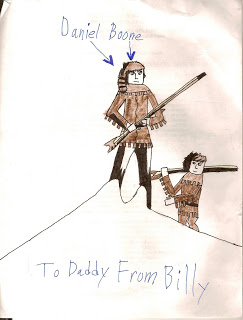
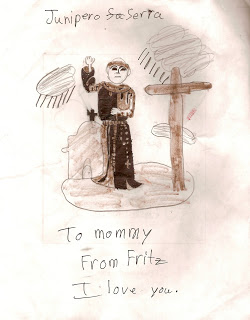
Fritz and I are reading George Washington’s World, and loving it. Billy is listening in and began copying the drawings found inside it, and then Fritz started doing it too. Had I actually assigned either one of them the task of drawing these historical people, they would have balked, of that you can be sure.

My kids hate crayons, and markers are too messy. For years I’ve been having them use colored pencils, and they’ve liked that okay. Recently, I bought a bunch of colored gel pens, and they really enjoy this medium. Colored pencils are cheaper, but the pens get better results.

Last year, we read a book on Daniel Boone. The boys pulled from that two important pieces of knowledge about Daniel: he got his own gun when he was twelve (they are counting the days), and he never really learned to read or write. I’ve tried to explain that there isn’t much of a living to be made in hunting and trapping nowadays, but that seems less important than the idea that you can be illiterate and famous.

You’ll notice Billy draws for his father and Fritz draws for me. I don’t know why that is. I do know that our first week of school, I had very seriously considered sending Fritz to our church’s school. Then I saw the $4000 price tag and came to my senses. Actually, I realized that sending him off to another teacher would only shift the homework struggles to the afternoon and evening hours; it wouldn’t actually make him a better student. Perhaps these “love notes” are his way of apologizing for all the wrinkles he’s causing his momma.

Despite the 4 day week, we should be getting all our work done today. I staggered my students’ school year starts. Katie and Jenny are finishing week 1; Billy is finishing week 2; and Fritz began his school year three weeks ago.
I do not recommend this.
The one who is supposed to be working is resentful that the others are not. The ones who are not working are upset that they don’t “get” to do school. My friend, Rachel, had a better idea of staggering subjects: first, Latin; then, math; etc. Next year, perhaps, I’ll try this.
Another great idea from Rachel was having blocks of time (yes, others recommend this too, but Rachel was right there with the suggestion when I needed it). I had put together a progression schedule, which was the order I wanted my students to tackle their subjects. If everybody progressed at a reasonable pace, I would be able to work with my kindergartener while my older students did independent work. Well, my older students don’t like to work at a reasonable pace, especially when it comes to math. I would send Fritz off to do math, and, an hour later, he would be a quarter way through.

Week 1 with Fritz was a difficult week.

Week 2, we began using half hour blocks of time. Although I may go over by a few minutes if they are almost done with an assignment, I try to move on at the end of the half hour to other things. I have 3 half hour segments for math for Fritz, including one segment which is about 15-20 minutes of speed drill, mental work, and lesson (Saxon math). He is much improved and mostly getting his work done within that time frame.
I also start Fritz early – no later than 8 am and by 730 if I can. This is hard on the other kids (Jenny and Katie) who want to begin too. But the girls are improving in their patience, and I think may grow to enjoy the 10 – 15 minute blocks of free time they get because their lessons only take a fraction of the time of their brothers.

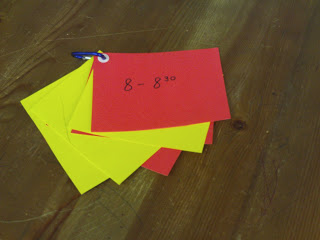
Last week, I used a hand-made chart to assign subjects for each student to the different blocks of time. It was a work in progress. After I added in the girls this week and saw how things meshed, my biggest problem was trying to see, at a glance, what we were supposed to be doing at a given time. Thrifty mom that I am (and lazy, too, not wanting to drag 6 kids to the store), I took some old pocket folders and cut them up into an index card size.

Notice the drawing on the front of the card? These cards will change as we work everything out, so using pristine cards or paper didn’t really make sense.

I made one card for each half hour block from 8 am until noon. On one side it has the time, and on the other, it has the time and each student’s assigned subject for that block of time. I punched a hole in the corner (and reinforced it), and connected them all with a caribiner clip we happened to have. (Pictures are blurry because my good camera is in Bulgaria with Bill). I like flipping the card to the appropriate time block and seeing what subjects we need to be tackling. Each student has a weekly checklist with the actual assignments.

So as we conclude these first, second and third weeks of school, I’m optimistic that it will be a good year. Having four students, especially when the older ones are unwilling to work independently, is challenging. But Fritz is starting to see that having the bulk of his work done before lunchtime is possible, and having the bulk of the afternoon free is wonderful, so his motivation is improving. I’m going to try to do one more complete week (next week), and then Bill should have a week off. Taking breaks when we want to is such a lovely advantage to homeschooling.

A Day Off Work

I didn’t move back to the area soon enough to go to the National IHM Conference, and my good friend (and my favorite vendor) aren’t going to the Catholic Family Expo in Baltimore, so I pretty much decided to not go to any homeschool conferences this year.

Then Margaret said she was going to the Family Centered Learning Conference, and Lancaster isn’t too too far away, so I decided to go.

And I’m so happy I did.

Homeschool conferences, especially faith-centered ones, are like day spas for your mind. It is so refreshing to be in a room full of funny, intelligent, charitable women who share your daily struggles and have similar hopes and dreams. It is nice to listen to speakers who do liturgical crafts with their children or one-on-one preschool time with the little ones even though they too have a large family. It is good to be challenged to challenge your children in their reading and writing and inspiring to hear how one woman struggles with a large family and a special needs child and still manages to be full of joy.

I’m glad it’s still summer, and I have another month to relax and think about school but not actually do it. I need this time off to recharge my energy level and my spirits. And even though I didn’t really know it, I really needed that conference.

Reading Level

I’m putting these links here so I can find them again, but perhaps there are others who could benefit from this information.

This link is a reading level assessment. There are two word lists and the student simply reads until it is too difficult. Note that this doesn’t judge comprehension. Billy was able to accurately pronounce the word “enumerate,” but he has no clue what it means.

This link gives instructions for evaluating the reading level of a document in Microsoft Word. The one bit of instruction left out is that you then do a spell check, and it will give you the information after that is complete. There are many uses for such a tool. You could type in a few paragraphs from a library book to see if it is a good level for your student. But most useful, I think, is in evaluating the student’s writing. It’s nice for evaluating your own writing too.

To understand the Flesch Reading Ease number, go here.

Gearing up for the new school year…

…and for life in general.

I’ve been reading this free e-book (Education is…) as well as the instruction manual for this P.E.G.S system, and I’ve been feeling like a bad mother.

In that e-book on Charlotte Mason-esque education, it lists 60 or so good habits and suggests working on them one at a time for about 2 months each. It also points out that at that rate it would take you ten years to get through the list. For someone like me who wants instant results, that seems like an awfully long time. But it serves as an excellent reminder that raising children into decent adults is an awfully long process.

Among the habits is listed Use of Time. Since our move last year, followed a few months later by the birth of Mary, my personal use of time has been less than stellar. And, unfortunately, when I fall apart (in one sense), it is unrealistic to expect my little children to keep things together. So meal times have not been at a regular hour, laundry is often done “as needed,” and bedtimes for me and the children have been later than I want.

I’ve been working on a schedule (with plenty of “margins”), and plan to implement some changes with the children beginning next week and taking a few weeks to fully affect. But this week, I’m working on me. I must, as much as possible, keep my own priorities in mind as I choose how to spend these lazy summer days. Is the laundry rotated? Is dinner prepped? Have the children done their chores? Did I spend any time reading to the children or playing a game with them?

Interestingly enough, I began my planning by first outlining a school day. I think a non-school day should resemble a school day as much as possible for consistency. The difference, of course, is that school work hours become free time.

And now, as the hour approaches 7 am, I must get off the computer and make some pancakes for my kiddos. If I’m really good and get my chores done, I’ll get to come back later!